Project Series
Pricing & Promotion Analytics Using Elasticity and Cost Efficiency
-
Date: Dec 2025
-
Tools: Excel
-
Data Source: Simulated pricing and sales data
-
Project Outcome: An analytics framework to support pricing and promotion decisions by integrating price elasticity and spending efficiency, enabling growth-oriented strategies while managing financial constraints.
Project Objective
This project demonstrates how pricing analytics can be used to support promotion and budget allocation decisions. Using weekly SKU-level data, I analyzed the relationship between price changes, sell-out performance, and promotional cost efficiency to derive practical pricing and promotion strategies under different budget scenarios.
Data & Analytics
Data Source:
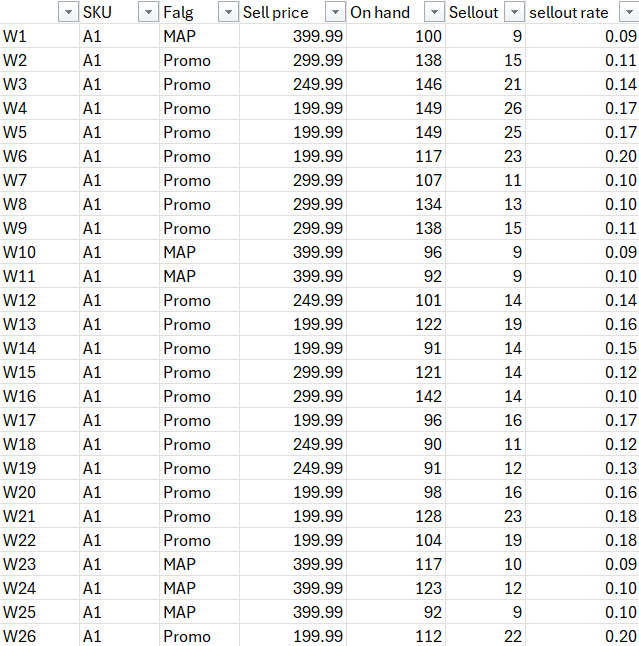
Simulated SKU-level pricing and sales data, designed to mirror real-world retail pricing and promotion patterns.
This simulated data includes:
-
Weekly data (W1–W52) at SKU level
-
Price status (MAP vs Promo)
-
Sell price
-
On-hand inventory and sell-out volume
-
Sell-out rate (= sell-out / on-hand inventory)
Analytics steps:
-
Calculated average sell-out rates by SKU and price tier
-
Estimated price elasticity based on percentage change in sell-out rate relative to percentage price change
-
Calculated Promo Spending per Unit Sold to measure promotion cost efficiency
-
Compared elasticity and per-unit promo spending across SKUs to evaluate pricing and promotion trade-offs
Pricing & Promotion Implications
Case 1: Budget sufficient, goal is sell-out / GMV growth
→ Prioritize high-elasticity SKUs where price reductions drive meaningful volume uplift
Case 2: Budget limited, goal is efficient exposure
→ Focus on moderate-elasticity SKUs with lower per-unit promo spending to maximize return per dollar spent
Case 3: Very low elasticity SKUs
→ Avoid deep discounts; use non-price levers such as bundles or free gifts instead

Key takeaway: Elasticity alone is not sufficient for pricing decisions; combining elasticity with per-unit promotional cost enables more budget-efficient growth strategies.